Heavy Metal Removal Agent
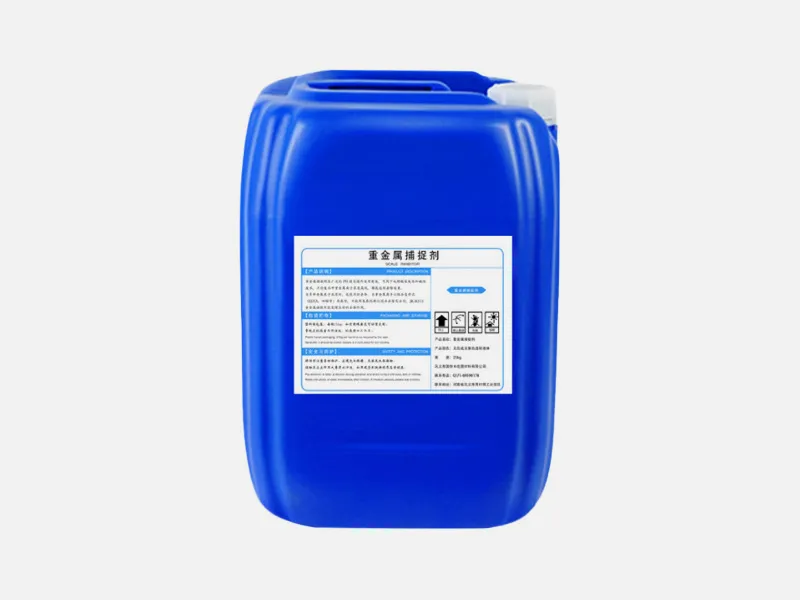
Heavy Metal Removal Agent Product Introduction
In wastewater treatment for industries such as electroplating, PCB manufacturing, and metallurgy, meeting heavy metal discharge standards is always a compliance red line hanging overhead: traditional hydroxide precipitation methods cannot handle complexed heavy metals, and effluent indicators such as nickel and copper repeatedly exceed limits, risking environmental penalties at any time; even after successful precipitation, a fluctuation in pH causes re-dissolution, keeping operations staff on edge daily; when multiple heavy metals coexist, several chemicals must be added, making the process cumbersome and management costs high; the resulting sludge volume is large and poorly stable, hazardous waste disposal costs remain high, and there is also a risk of secondary pollution. This heavy metal removal agent (also known as heavy metal capture agent or chelating precipitation agent), developed by Jing'anlan Environmental Technology, is a polymer water treatment chemical built around highly active chelating functional groups. The molecular chain is uniformly distributed with a large number of dithiocarbamate active groups, which can undergo strong chelation reactions with various heavy metal ions such as copper, nickel, cadmium, lead, zinc, chromium, and mercury, forming stable insoluble five-membered ring chelate precipitates. Whether free-state heavy metals or difficult-to-treat complexed heavy metals such as EDTA, citric acid, and ammonia complexes, all can be efficiently removed, solving the industry pain point of unstable heavy metal compliance from the root.
Core Value and Product Advantages
1. Strong chelating ability, stable precipitation without re-dissolution
The chelates formed by this product with heavy metal ions have a stable structure and extremely low solubility, far superior to traditional hydroxide precipitation. Under environmental changes such as pH fluctuations and water disturbance, heavy metals are not easily re-dissolved, providing stronger long-term compliance assurance and completely solving the pain point of "re-dissolution after precipitation and repeatedly fluctuating indicators," greatly reducing the risk of excessive discharge.
2. Direct treatment of complexed states, no additional decomplexation needed
Breaking through the limitations of traditional hydroxide precipitation methods, it also has good removal effects on complexed heavy metals in forms such as EDTA, citric acid, and ammonia complexes, without the need for additional oxidative decomplexation processes, new treatment equipment, or tanks, saving infrastructure investment and floor space while greatly simplifying the treatment process.
3. One agent for multiple uses, simultaneous removal of multiple heavy metals
A single chemical can simultaneously treat multiple heavy metal ions such as copper, nickel, cadmium, lead, zinc, and reduced hexavalent chromium, unaffected by coexisting ions in water, perfectly adapting to multi-metal mixed wastewater scenarios. No need to stock multiple chemicals, reducing inventory management costs and making on-site operation simpler.
4. Wide pH application range, simpler operation
Delivers stable removal performance across a wide pH range of 4-12, eliminating the need for repeated acid or alkali dosing to adjust wastewater pH. This reduces acid/alkali chemical consumption and lowers operational complexity for maintenance staff. Even when influent pH fluctuates, treatment performance remains stable.
5. Less sludge and more stable operation, reducing hazardous waste risk
Compared with traditional chemical precipitation methods, Jing'anlan heavy metal removal agent produces less sludge volume with lower moisture content. It delivers excellent heavy metal solidification, is less prone to leaching, and carries low secondary pollution risk. The amount of sludge requiring hazardous waste disposal is significantly reduced, greatly lowering long-term hazardous waste disposal costs while improving environmental compliance.
Applicable Industries and Scenarios
Electroplating and surface treatment industry: advanced heavy metal treatment for electroplating rinse water, passivation wastewater, plating bath waste liquid, etc.
PCB and electronic components industry: treatment of wastewater containing heavy metals such as copper and nickel, including etching wastewater and electroless nickel-gold wastewater
Non-ferrous metallurgy and mining industry: heavy metal treatment for mining, ore dressing, and smelting wastewater
Battery and stainless steel processing industry: treatment of heavy metal pickling wastewater containing lead, cadmium, chromium, etc.
Waste incineration plants and landfills: heavy metal removal from leachate
Chemical, leather, and printing & dyeing industries: upgrading and compliance improvement of wastewater containing heavy metals
Usage Recommendations & Product Selection Guide
Wastewater from different industries varies greatly in heavy metal types, concentrations, and complexation levels, so there is no universal dosage ratio. To ensure compliance and control costs, Jing'anlan Environmental Technology recommends first conducting a small-scale water sample test to determine the suitable product model and optimal dosage. General usage reference: liquid products can be added directly or after dilution; solid products are recommended to be prepared as a 5%-10% aqueous solution before dosing. The recommended dosing point is after the coagulation reaction tank or pH adjustment tank, ensuring a reaction time of 5-15 minutes. The typical dosage is 50-500ppm; for wastewater with high heavy metal concentrations and deep complexation, the dosage can be appropriately increased. After the reaction, flocculation and sedimentation with PAC and PAM can further enhance solid-liquid separation, and the treated effluent can stably meet the Table 3 discharge standard.
Jing'anlan Service Support
We focus on heavy metal wastewater treatment and provide an integrated "chemicals + technology" solution.
Free water sample testing and heavy metal removal trials, precisely matching chemical models, and providing a dedicated dosing plan and cost estimate
Technical engineers provide on-site guidance and commissioning, assisting in optimizing process parameters to ensure stable compliance
Stable production capacity guarantee, regular models kept in stock, and rapid response for emergency replenishment
Customized formulas available for difficult complexed heavy metal wastewater, solving complex water quality compliance challenges
If you are troubled by difficult-to-treat complexed heavy metals, repeatedly exceeding standards, and high sludge disposal costs, contact Jing'anlan Environmental Technology for free water sample testing services and a customized, compliant, and cost-effective heavy metal treatment solution.
Product Inquiry
Are you interested in this product? Please contact us.